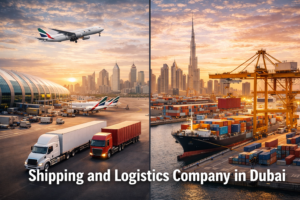
Choosing between road, sea, or air freight is not as simple as it seems. Every mode plays a crucial role in the supply chain, and each comes with its strengths, limitations, and price differences.
For businesses, missing the right transport mode can mean:
- Delayed shipments
- Higher logistics costs
- Damaged goods
- Lost clients
That’s why a professional Shipping and Logistics Company in Dubai – like Overseas Gate Shipping- uses a strategic, data-driven approach to choose the right mode for every shipment.
Dubai’s world-class infrastructure makes it a global logistics hub, but it also demands smart decisions to move cargo efficiently.
Let’s break down how logistics experts decide between road, sea, or air.
Table of Contents
- Why the Right Transport Mode Matters
- Key Factors Logistics Companies Consider
- Speed & Delivery Time
- Cost Efficiency
- Cargo Type & Sensitivity
- Route Availability
- Customs & Compliance
- Road Freight: When It Is the Best Choice
- Sea Freight: Ideal for Large, Global Shipments
- Air Freight: Fastest but Premium
- Real-World Example from Dubai’s Logistics Sector
- Expert Insights & Pro Tips
- Conclusion
- FAQs
Why Choosing the Right Transport Mode Matters
A wrong decision doesn’t just affect timelines. It affects:
- Profit margins
- Inventory planning
- Customer satisfaction
- Regulatory compliance
As per a global logistics report by FreightWaves, “Choosing the correct transport mode can reduce supply chain delays by up to 40%.”
This makes mode-selection one of the most important decisions for any logistics company.
Key Factors Logistics Companies Consider
a) Speed & Delivery Time
If the shipment is urgent, perishable, or part of a just-in-time supply chain, air freight becomes the top priority.
For flexible or high-volume shipments, sea or road is preferred.
b) Cost Efficiency
- Air freight = highest cost
- Sea freight = best for bulk + long distance
- Road freight = economical for GCC + regional
Logistics companies balance cost with speed to find the right match.
c) Cargo Type & Sensitivity
Certain goods require specific transport:
| Cargo Type | Recommended Mode |
|---|---|
| Electronics | Air |
| Construction materials | Sea / Road |
| Fresh food | Air / Reefer road |
| Bulk machinery | Sea |
| Retail goods | Sea / Air mix |
d) Route Availability
Dubai offers:
- 2 major seaports (Jebel Ali, Port Rashid)
- 1 major international airport hub (DXB + DWC)
- Road links connecting UAE, Oman, Saudi, Bahrain, Kuwait, and beyond
Logistics companies analyze which route ensures smooth transit.
e) Customs & Compliance
Sea and air freight have complex documentation.
Road freight requires GCC permits.
Logistics teams choose modes that minimize delays.
Road Freight: When It Is the Best Choice
Ideal For:
- Regional GCC deliveries
- Short to medium distances
- Heavy, non-urgent cargo
A Shipping and Logistics Company in Dubai uses road freight for flexibility and door-to-door convenience.
Pros
- Fast customs clearance
- Lower cost compared to air
- Great for last-mile delivery
Cons
- Weather delays
- Road restrictions
- Limited for cross-continent shipments
Sea Freight: Ideal for Large, Global Shipments
Ideal For:
- International shipments
- Heavy, oversized cargo
- Containers (FCL/LCL)
Sea freight is the backbone of global trade.
Pros
- Cost-effective
- Handles bulk cargo
- Eco-friendly
Cons
- Slower transit
- Port congestion
- Requires advance planning
Common Sea Freight Cargo
- Vehicles
- Construction equipment
- Retail goods
- Industrial machinery
Air Freight: Fastest but Premium
Ideal For:
- High-value items
- Perishables
- Time-sensitive shipments
Pros
- Fastest delivery
- Secure handling
- Reliable scheduling
Cons
- Expensive
- Weight/size limitations
Air freight is often chosen by companies that prioritize speed over cost.
Real-World Example: How Dubai Logistics Companies Decide
A retail business in Dubai needs to import urgent electronics from Germany.
The logistics team reviews:
- Delivery deadline: 3 days
- Cargo type: fragile, high-value
- Budget: flexible
Chosen Mode → Air Freight
Because speed + safety > cost.
Another example:
A construction company needs 50 tons of steel from China.
Factors:
- Not urgent
- Heavy
- Price-sensitive
Chosen Mode → Sea Freight
This is exactly how a Shipping and Logistics Company in Dubai optimizes client shipments daily.
For a deeper understanding of how freight moves through Dubai’s ports, warehouses, and logistics hubs, explore this article
Expert Insights & Pro Tips
Expert Insight
“Over 70% of businesses in Dubai use hybrid logistics—combining sea + road or air + road—to reduce costs while maintaining delivery speed.”
— Regional Logistics Analyst, UAE
Pro Tip
Always check Incoterms, insurance, and customs regulations before choosing the freight mode. These hidden factors can impact total cost significantly.
Conclusion
Choosing between road, sea, or air transport is a strategic decision-not a guess.
A reliable Shipping and Logistics Company in Dubai evaluates:
- Cargo type
- Delivery timelines
- Budget
- Route access
- Compliance
This ensures your shipment arrives safely, quickly, and cost-effectively.
If you want tailored logistics solutions backed by industry expertise, Overseas Gate Shipping LLC is one of the Best Logistics Companies in Dubai for international freight.
FAQs
1. What is the most cost-effective shipping method?
Sea freight is the cheapest for international bulk shipments.
2. What is the fastest mode of transport?
Air freight is the fastest but also the most expensive.
3. Which mode is best for GCC deliveries?
Road freight is ideal for UAE–Saudi–Oman–Kuwait regional deliveries.
4. Can logistics companies use more than one mode?
Yes. Multi-modal (road + sea) is common for optimized cost and speed.
5. How do I choose the best logistics company in Dubai?
Check experience, fleet strength, network coverage, pricing, and customer reviews.